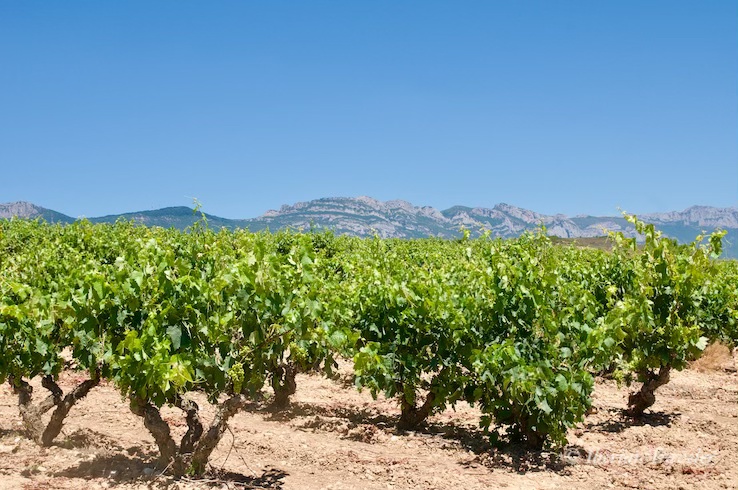
The Najerilla river flows from the mountains of the Sierra de la Demanda to the Ebro River, making this a special corner of La Rioja, with a unique style of wine, the lower part of the valley yielding the region’s most balanced wines. The valley, considered by many to be central to La Rioja vineyards, is one of the Seven Valleys of the Rioja, has the greatest number of acres dedicated to wine growing in the Rioja Alta, with some of the oldest terraces carved out of the hillsides higher up in the valley. And here is where you will find Najera, the ancient capital of the kingdom of Navarra.
If you divide the valley in half, the middle of the valley, with the highest terrain, home to the Garnacha grape, is where the classic Riojan “claretes” are made, rivaling those from Cordovin, San Asensio and Badaran. The lower part of the valley, which is more open, could be considered the Ebro Valley itself rather than just its tributary. It is one of the most densely planted areas, with a penchant for Tempranillo. The lower end of the valley also includes two Iron Age hilltop settlements, Castillo Antiguo, and Cerro Molino, which is near the village of Hormilleja, and known locally as “El Risco”. They belong to the Celtiberian period, fourth to the second centuries BC.
For more information, see: A valley in La Rioja: The Najerilla Project.

Wineries of interest
- Bodegas Ayagar
- Zinio Bodegas
- Bodegas Viña Berneda SL
- Bodegas Martinez Corta
- Bodegas Leza García
- Bodegas Cuna de Reyes
- Bodegas JER
- Bodega Real de Nájera, SC
- Bodegas Pedro Martinez Allegiance
- Bodegas David Moreno
- Viñedos El Pacto (Alto Najerilla)
- Bodegas Gama (Alto Najerilla)
- Bodega César del Río
- Bodegas Trodos Quattro
- Bodegas Florentino Martínez
- Bodegas Hnos. Lozano
- Bodegas Najerilla
- Bodegas Fin de Siglo
- Bodegas Horola
- Bodegas Juan Carlos Sancha
Hormilleja
This small farming village of 180 inhabitants, where the Najerilla and Tuerto Rivers meet, can be found just off the LR-208, a couple of minutes north of the A-12. On Jueves Lardero, Fat Thursday, the traditional Christian feast marking the last Thursday before lent, the children of Hormilleja go from house to house singing and to collect eggs. 50 days following Easter, coinciding with Pentecost Sunday, they celebrate the Virgin of the Rosary with a pilgrimage, La Media Legua, the 2-1/2 km walk (half a League) enlivened by the sound of bagpipes and dulzainas, a Spanish double reed instrument, accompanied by traditional dances.
Bodegas Ayagar
Located just outside of the historic village on the Camino Valpierre surrounded by vineyards with the snowy mountains of Valdezcaray, the Riojan Valley and the Basque mountains as a backdrop. The small family winery began in 2004 and today they make just four wines, two reds, a rosé of 75% Viura and 25% Tempranillo, and a white of 100% Viura.
Uruñuela
Across the Yalde river valley from Hormilleja, the small village of Uruñuela was founded in the 10th-century by Najerino García Sánchez, king of Pamplona during the repopulation of La Rioja. Life here is centered around the production of wine with more than 800 hectares of vineyards under cultivation. The village begins the year with a two-day celebration of San Ignacio de Antioquia and Las Candelas (candles), with the Procession of Light, beginning February 1. On the 1st Sunday in May it’s time to celebrate La Virgen de las Espinas, and on 15 May, San Isidro, the patron saint of farmers. On the 3rd Sunday in August they celebrate La Virgen del Patrocinio with a feast.
Zinio Bodegas
This modern winery is surrounded by more than 450 hectares of vineyards at an elevation of between 450 and 590 meters above sea level at the north end of the Najerilla Valley, is the result of 200 wine growing families getting together in 1985 to begin producing their own wines. The first harvest for Bodegas Patrocinio was in 1986, the first bottling came in 1993. It has an ideal climate as it is bordered on the north by the Sierra Cantabria Mountains and to the south by the Sierra de la Demanda. We stopped by this past July and were quite impressed with their wines and the new gastrobar.
Bodegas Viña Berneda SL
Opened in 1981 in by Jesús Amor Artacho as a family project, ten years later that the “Viña Berneda” brand wine was born. The vineyards, located in Cenicero and Uruñuela, average 30 years of age, but the most select wines are from vineyards over 100 years old. The Berneda Reserva, 100% Tempranillo, spends 18 months aging in American oak, while the Berneda Crianza Vendimia Seleccionada spends 12 months in American oak.
Bodegas Martinez Corta
Opened in 2005, this 21st-century winery, located to the northeast of Uruñuela, just off the LR-113, has deep roots built up over four generations (since the 1960s), when their first vines where planted along the slopes of the Najerilla river, below Torremontalbo. The family winery is part of Bornos Bodegas group of wineries which cover six of Spain’s major wine regions. The Martinez Corta vineyards cover 80 hectares from the upper zone of Cenicero to the banks of the Najerilla river.
Bodegas Leza García
Juan Leza Arenzana started the family winery in the early 20th-century, opening the winery at Calle San Ignacio, 26, in Uruñuela, making excellent wines at affordable prices, including their Valdepalacios Crianza, 85% Tempranillo, 10% Red Grenache and 5% Mazuelo, is aged for 12 months in American and French oak, with 6 months in a bottle before being released. All of their vineyards are all located in the Najerilla Valley.
Nájera
The noble town of Nájera, the “King’s Court”, was the former capital of the Kingdom of Navarre during its age of splendor and is a major stop on the popular Camino Francésor French Way on the Camino de Santiago. Take a walk around the towns’s historic district and visit it’s historic monastery, the Monastery of Santa María la Real (1032), a majestic landmark. The town was occupied by the Moors in the 8th-century, who called it Naxara, “the place between rocks”. Be sure to visit the Nájera caves, open Saturday, Sunday and Wednesdays. The Alcazar, El alcázar de Nájera was built by the Arabs in 1020 at the same time as the Castillo de la Mota, which sits on the hill overlooking the town and was important during the struggles between the Moors and Christians for hundreds of years.
For lunch in Nájera you can check out the Meraki Gastrobar, Mesón Jamonero or La Mercería Restaurante. Or if you are up for something a bit more upscale today, then reserve a table at Venta Moncalvillo, 2 Michelin stars and 2 Repsol suns, about 20-minutes away in Daroca de Rioja.
Bodegas Cuna de Reyes
This modern family winery called the “Birthplace of Kings” was founded in 1999 along the road from Nájera to Uruñuela. All of their wines, overseen by winemaker Alfredo Ciria, are from their own vineyards, Finca Las Cabras, as well as from select vintners in the area. The Cuna de Reyes Crianza, 80% Tempranillo, 15% Garnacha, 5% Mazuelo, is aged for 12 months in American and French oak with two rackings.
Bodegas JER
Now in it’s third generation, dates to 1954 when Javier Cantera Cañas built his first winery in the village of Azofra, an important crossing point on the pilgrimage’s route. His son, Javier Cantera Corcuera, opened the modern winery in 2000 in nearby Huércanos and was joined by his daughter Eva Cantera in 2010. Their high altitude vineyards in Alto Najerilla, at 600 meters and between 40-60 years old, and produce a limited production of very high quality and complexity.
Bodega Real de Nájera, SC
Orginally founded in 1962 as ‘Bodega Interlocal Cooperativa’, a new winery was built in 2000 and the name changed. There are currently 190 members of the cooperative with 650 hectares of vineyards in and around the villages of Azofra, Nájera, Hormilla, Hormilleja and Arenzana de Abajo.
Badarán
The small village of Badarán, with around 700 inhabitants, was settled in the 10th-century, but there are remains of several Roman settlements in the area and evidence that the area has been populated since prehistoric times. Badarán holds a gastronomic festival the first Sunday in July to promote local products and as a prelude to the festivities in honor of the Virgin de la Asunción and San Roque in mid-August. Bodegas David Moreno has a Harvest Day festival, a Jornada de Vendimia, in late September. There is also a weekly market on Fridays at the Plaza Conde. While there be sure to visit Almazara Villasante to pick up some of their excellent olive oils.
For lunch in Badarán there is Restaurante Comercio, La Taberna, Cantinflas 2 and the Mesón Conde de Badarán.
Bodegas Pedro Martinez Alesanco
The Martínez Alesanco Family has been harvesting the grapes in the red soil of Badarán near San Millán de la Cogolla, in the heart of Rioja Alta, for centuries. Goblet-trained Tempranillo grows on their Valle de San Millán vineyards. Viura is planted in the Ribamaría vineyard at an altitude of 600 meters. The Maturana Tinta grows at an altitude of 700 meters in the El Hombo vineyard in the heart of the San Millan Valley. Tempranillo is planted at the north-south facing El Campillo vineyards as well as in the centuries old Las del Rey vineyards. You’ll find more Tempranillo grapes on high trellises at the La Patada vineyard in Badarán and Red Garnacha at the Vallejo Las Suertes vineyard.
Bodegas David Moreno
We first visited David during a tour with the Tourist Office of Spain in the spring of 2003. Once an engineer working in Barcelona, the winery began step by step in 1988 when he returned home, and in 1991, opened his first cellar, in the clay and stone called “Don Pociano”. The third cellar was finished in 2013. His daughters Gemma and Paula had become involved in the winery in the mid 90s. The winery controls 130 hectares of vines in the Alto Najerilla, all within 6 kilometers of the winery, which itself is only 8 kilometers from the monasteries of Yuso and Suso de San Millán de la Cogolla.
Cárdenas
Around the small village of Cárdenas in the Alto Najerilla Valley, dating from the 10th-century, is where you will find fields for hunting partrige, rabbit and hare and fresh trout from the Cárdenas river. The Alto Najerilla Valley, located at the foot of the Sierra de la Demanda and crowned by the San Lorenzo peak at an elevation of 2,200 meters and is one of the Rioja’s best-kept secrets. Climate change and rising average temperatures have driven a change in the vineyards above 600 meters.
Viñedos El Pacto
Here is where you will find the roots of centuries-old vines contain the essence of Rioja’s freshest Garnacha, Valdechuecas, from a plot of 0.875 hectares (2.16 acres) with 4,000 old vines grown between 595 and 620 meters. The family has a second winery, El Pacto de la Sonsierra, with vineyards in Baños de Ebro, Villabuena de Álava, Navaridas, and San Vicente de la Sonsierra, for a total of 27 plots of old organic vines. Viñedos El Pacto is a return to the origins with a clear goal in mind: to prevent true village wines from becoming extinct. A handful of old vines, unscathed by the industrialization maelstrom, have preserved the value of small-scale, manual labor, and respect for natural cycles. This pact of gratitude and continuity is born in the heart of Rioja, in the Sonsierra and the Alto Najerilla, uniting past and present to ensure the future.
Bodegas Gama
This family winery, completely updated and reopened in 2011 and is the smallest winery in the Rioja. It’s located on the eastern edge of the village and produces Garnacha from their 80+ year old bush-trained vines planted by the grandfather. The winery is name for it’s owners, Antonio García and Carlos Manzanares. The winery consists of three floors; the basement where the wine is made, the first floor which is the tasting and meeting area and finally, the second floor, where the storage and bottling area is located.
Cordovín
The tiny hamlet of Cordovín, in the extreme northwest of the San Millán Valley, was settled in the 10th-century and is known for its Clarete, a wine visually similar to rosé, but made in a similar way to red wine, making the maceration prior to the fermentation of the wine, with the skins, but with a good proportion of white grapes, so that a wine of pale bright pink, fresh and very fruity. There is a pilgrimage to the Hermitage of San Cristóbal with traditional dances the first Sunday in May. In mid July they celebrate the patron saint, San Cristóbal, and on the third Sunday in September is the Fiesta de San Jerónimo Hermosilla, following up on Monday with a Brotherhood meal for the entire town. For lunch in the area you should head to Badarán.
Bodegas César del Río
The family winery was opened in 1988 at Camino de San Martín, 57, in Cordovín, in the cradle of the traditional Riojan claret. César and his winemaker son Iván opened a new bodega a few minutes away Alesanco in the middle of the Ruta de the Monasteries of La Rioja Alta in 2015. Their top wine ‘Yursun’, alludes to the nearby Yuso monastery. The claret is fresh, bright and fruity, made from grapes harvested by hand from vineyards located in the Cordovin area with an average age of 30 years. Their 2020 Liberatus La Aguzadera Garnacha is a limited bottling of only 855 bottles.
Bodegas Trodos Quattro
This winery at Camino San Martín, 1 , in Cordovín, was created in 2003, born from the initiative of four friends (“Quattro”); Alberto Pérez, Alfredo Lozano, Ángel Olmos and Juan María Lecuona who were passionate about the world of wine had a long-standing illusion of being able to make a great wine with its own personality and character, from their own vineyards, some now more than 100 years old. Their 2015 Trodos IV Vendimia Seleccionada, limited edition (6000), of 100% Tempranillo, is aged for 27 months in French and American oak in a centuries-old cellar.
Bodegas Florentino Martínez
Florentino Martínez opened his new winery at Calle de la Ermita, 33, in 1992, combining several smaller centuries-old locations in Cordovín where the family sold their wines. All of their wines are from their own vineyards, including the limited production Distercio. They also produce a wine from the near-extinct red wine grape, Tinto Maturana, discovered by Riojan viticulturist Juan Carlos Sancha from Baños de Río Tobía. Both the Distercio and Tinto Maturana wines are aged in native Riojan oak barrels from the nearby mountains.
Bodegas Hnos. Lozano
For more than five generations the Lozano family has been involved in making wines from the vineyards to the wooden press and concrete vats, which in 2000 gave way to modern stainless steel tanks and horizontal presses. The wine is still aged in oak barrels and the harvest is done by hand.
Arenzana de Abajo
Another small farming village, this one dating from the year 1020, Arenzana de Abajo has less than 300 inhabitants but several large houses with coat of arms and the 16th-century Church of La Asunción. The 5-day festival of the Virgen del Carmen happens in mid-July. On September 8 they celebrate the Nuestra Señora de la Antigua, with the festival of the Pimiento y la Anchoa being held the Sunday before.
Bodegas Najerilla
Established in 1975 by 300 families from the villages of Alesón, Arenzana de Abajo, Arenzana de Arriba, Badarán, Baños de Río Tobía, Bezares, Bobadilla, Camprovín, Cárdenas, Manjarrés, Najera and Tricio. The modern winery, opened in 1981, sits along the LR-113, before the turnoff to Arenzana de Abajo, in the Bajo Najerilla valley, the high Rioja. The families have more than 1100 hectares of vineyards, who with care and patience, generation after generation, cultivate, harvest, make, breed and love their wine. The cellars hold 2,500 oak barrels.
Bodegas Fin de Siglo
This beautiful winery-estate, created in 1999 by a small group of local families, vine growers for many generations, has been a part of the Peralada Castle’s Wineries Group (Girona) since 2014. The winery has 45 hectares of their own vineyards with vines that are more than 100 years old and manage an additional 10 hectares between Nájera and Arenzana de Abajo.
Baños de Río Tobía-Bañuelos
This village of around 1700 inhabitants in the Najerilla River basin at the foot of the Sierra de la Demanda is better known for its artisanal Duroc hams; Jamón Sobrón, Amando Loza, Martínez Somalo, Villoslada and el Riojano, then it is for it’s wine, but at the north end of Baños de Río Tobía-Bañuelos you’ll find Bodegas Horola and Juan Carlos. It is believed that Santo Domingo de Silos was born in Bañuelos in the year 1000. The village has a long history of Pelota with several famous Pelotari, hand ball players. Next year will mark the 52nd Festival del Chorizo, which begins the Sunday before San Mateo. Market day is every Wednesday.
Bodegas Horola
The Hornos family, with more than 100 years of history, stories and legends, owns a modest 7.5 hectares of vines between 30 and 110 years old in the Alto de San Antón (Yalde river basin). The Horola Garnacha, harvested in the first week of October at an altitude of 600 to 700 meters, was aged 11 months in 500-liter French Oak. The premium barrel fermented Horola MIL, 100% Tempranillo, was aged for 12 months in 225-liter French Oak and finished with 6 months in the bottle.
Bodegas Juan Carlos Sancha
Juan Carlos, who started his project in 2008, is a professor of enology at the University of La Rioja. His small winery sits on 5 hectares of vineyards just to the north of the village where he specializes in the production of artisan organic wines elaborated from the minority varieties of Tempranillo Blanco, Maturana Tinta and Maturana Blanca, varieties that he and his university colleague, Fernando Martinez de Toda, discovered, rescued from extinction, and developed.


 Destinations by Maribel